About Rohan Gillett & Tokyo Snapped
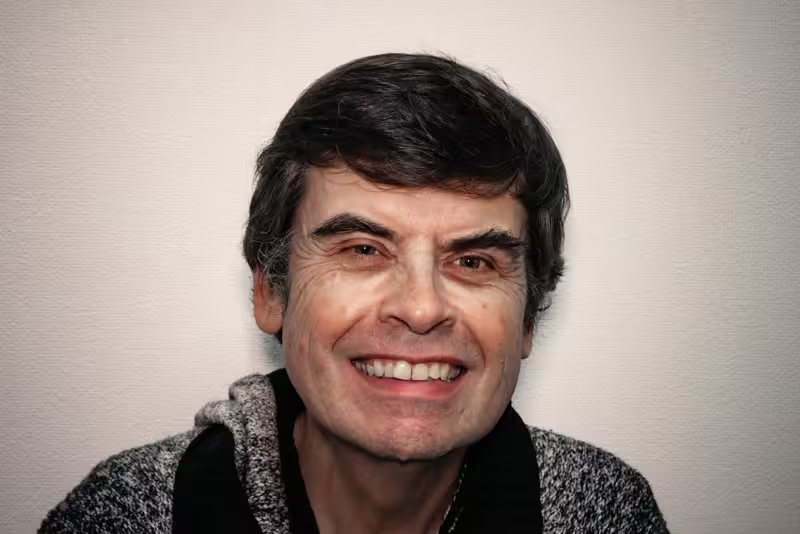
Who is Rohan Gillett
That’s me. I’m an Australian guy born in 1965 who never thought he’d end up in Japan. My only connection with the country in my younger days was through a TV show, “The Samurai” which was made in the 1960s. My family also hosted some exchange Japanese students in the 1970s through my father’s Lions Club connections.
Throughout my early years I lived on Queensland’s Sunshine Coast, just north of Brisbane. After working in the state’s Justice Department for a few years I quit and went to Griffith University in 1990.
How did I end up in Tokyo?
At university, I met a Japanese girl and we decided to marry. I thought I’d better learn Japanese, so we came here for two years. Her family was in Tokyo so that is where we went in 1991. I worked as an English teacher at NOVA, the biggest private school in the country at the time.
We returned to Australia in 1993. After graduation, I returned by myself to Tokyo in 1996 and have been here ever since. My wife preferred Australia, so we decided to split.
Tokyo then and now
For over three decades, I’ve explored Tokyo. From the neon-drenched roads of Shinjuku to the quiet, lantern-lit alleys of Yurakucho, I’ve walked many miles. My goal was always to understand its pulse.
Tokyo is a living entity—constantly evolving and revealing new secrets. I must admit I didn’t use a camera for my first twenty years. That is something I deeply regret. How can I explain this city?
I don’t know where to start. It would probably take a year to tell you everything. Here are the main things I remember from 1991:
- Rainbow Bridge was still being constructed.
- Tokyo Tower wasn’t as hemmed in as it is now.
- The Shiodome area was flat and lacked any type of skyscraper.
- Foreign tourists were almost absent from the streets.
- Most foreigners here seemed to be English teachers. Did anyone else work at NOVA?
- One group that is long-forgotten is the Iranians. They mainly worked in construction and manufacturing. On weekends, huge groups of them hung out in Yoyogi and Ueno Parks. Maybe they were a precursor to the overtourism we see today.
- Everyone wore jeans, even in summer. It was rare to see adults in shorts.
- Pasmo and Suica were in the distant future. We had to make do with paper tickets or train passes.
- Steve Jobs hadn’t given us iPhones either. I kept a bilingual atlas of Tokyo in my bag. It was a little book but it covered all the city’s twenty wards and it took me everywhere.
From explorer to photographer
After twenty years of exploration, I realized that my memories weren’t enough. I felt a need to share the Tokyo I knew with the world. In 2011, I started a blog (now long gone), but words alone couldn’t capture the city’s energy. Photography became a necessity. The images on this blog date from 2016 until the present (with everything remastered for this website).
I bought my first “serious” camera and embarked on a new journey: learning to capture light, shadow, and emotion. While my work has been featured professionally and I’ve built a following through platforms like Instagram, I still consider myself a dedicated student of the craft. With a city as dynamic as Tokyo, and an art form as deep as photography, the learning never stops.
Do I have a photography philosophy?
While I photograph all of Tokyo, I find myself drawn to many themes. In my street photography, I look for the ‘quiet’ within the chaos—the solitary figure leaving a station at night. My aviation and car photography allow me to play with speed and form, while long-exposures help me capture the city’s neon pulse in a way the human eye cannot.
Perhaps my most personal project involves the city’s older cemeteries. I find Japanese grave architecture and the serene, wooded atmospheres of these ‘cities of the dead’ to be a sublime contrast to the concrete jungle outside their gates.
If you are new to the site, I recommend starting with my most meaningful long-term projects–my deep fascination with Tokyo’s historical cemeteries; you can read my guides to Aoyama Cemetery, the literary history of Zoshigaya Cemetery, or the shogunal Yanaka Cemetery.
If you’re here for the blossoms, my Chidorigafuchi Crowd Strategy is a ‘time capsule’ post from 2017 that still holds the secret to enjoying the moat in peace today. See where the links take you.
My gear and recommendations
Many people ask about the tools I use. In years past, I used Fujifilm, Sony, and Pentax. I currently shoot with a Canon EOS R5. Why did I change? Their color science is superb, as is their range of lenses. The focus system is incredible. Professional support is excellent too.
If you’re looking to buy camera gear in Tokyo, head to MapCamera in Shinjuku. I have bought all my equipment there since 2017. Their service and trade-in values are outstanding.
Tokyo Snapped is more than just an archive; it’s a living project. If you’d like to find me on social media, follow the links below. There is also a contact form in the footer for business enquiries.