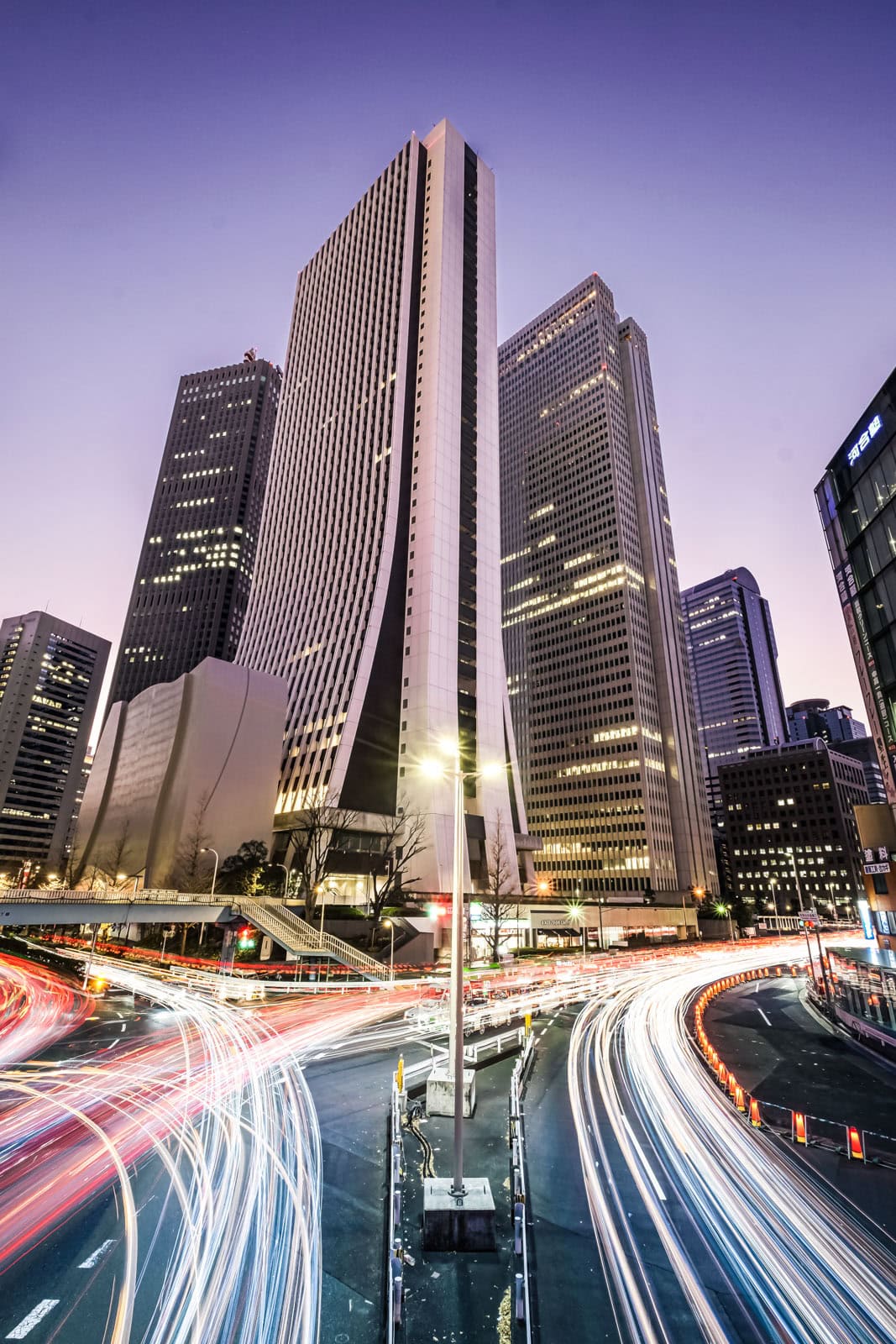
The Sompo Japan Building that looks over Nish-Shinjuku is more than just a skyscraper. It resembles a fortress of the future. From a nearby bridge, you can watch mesmerizing light trails weave around its unique, sloping walls like rivers of light. It’s a dream shot for any long-exposure photographer.
For me, this view captures modern Tokyo: bright, powerful, and pulsing with energy. This is my guide to capturing the building, using a long exposure. To learn more about this technique read [How to Take Long-Exposure Photographs: A Beginner’s Guide].
Sompo Japan is a top photo spot
What makes the Sompo Japan Building such a rewarding subject for Tokyo night photography is its unconventional design. Instead of rising straight up, its walls gently slope inward from a wide base before shooting 193 meters into the sky.
The unique curvature gives it an imposing, fortress-like presence that stands out even in a skyline as crowded as Shinjuku’s. Fun fact: it houses the headquarters of Sompo Japan, one of the country’s largest insurance firms.
Where to take this image
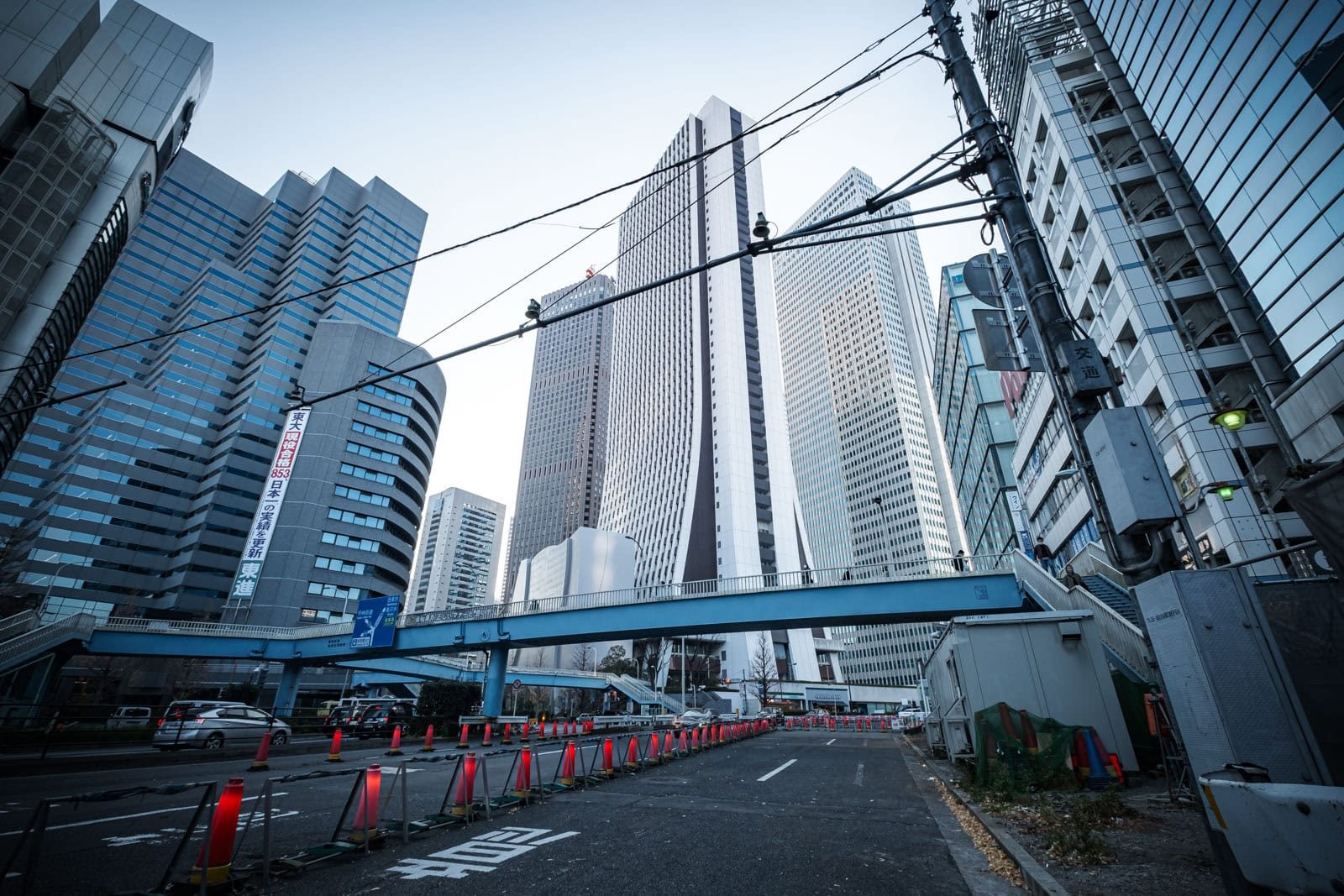
The best spot to capture this shot is from the New City Pedestrian Bridge (新都心歩道橋). From here, you are perfectly positioned above Ome-Kaido Avenue. As traffic floods beneath you, the headlights and taillights create stunning trails that diverge around the base of the building, framing it perfectly.
How to take this photo
Recommended photography gear
Capturing the flow of light requires a long exposure, which means you’ll need a tripod and a cable release to keep your camera perfectly still.
I also recommend an L-bracket to put your camera in a portrait orientation, which helps emphasize the skyscraper’s height. You could even use an ND filter to control the amount of light. For this shot I used a Fujifilm X-T3 with the Fujifilm XF 16-55 mm F2.8 R LM WR lens.
Camera settings
- Aperture: f/11. This gives you a deep depth of field, ensuring both the foreground bridge and the distant building are sharp. It also helps create those beautiful, sharp “starbursts” from streetlights.
- ISO: 200. I used the base ISO to keep digital noise to an absolute minimum, resulting in a cleaner, smoother image.
- Shutter speed: 20-30 seconds. This range is long enough to turn passing cars into smooth, flowing ribbons of light.
- Taking only one photo will result in a single light trail which won’t be impressive. Therefore, take multiple shots (I took nine) and stack them in Photoshop using the process outlined below. Done correctly (and provided the traffic cooperates), your image be a veritable wall of colors.
Stack the photos for better light trails
For this I use Adobe Photoshop, here are the steps to do stacking:
- Go to File > Scripts > Load Files into Stack
- Click Browse and select all the images you want to stack.
- If you didn’t use a tripod or there’s slight camera movement, check the box that says “Attempt to Automatically Align Source Images.”
- Click OK. Photoshop will open a new document with each photo on its own layer.
- Edit as you please.
Plan your photo trip
How to get to the Sompo Building
The Sompo Japan Building and the pedestrian bridge are located in Nishi-Shinjuku, a short walk from one of Tokyo’s biggest transport hubs.
- Address: 1 Chome-26-1 Nishishinjuku, Shinjuku City, Tokyo
- Bridge name: New City Pedestrian Bridge (新都心歩道橋)
- Nearest Stations: Shinjuku Station (JR Yamanote, Chuo Lines, etc.) or Nishi-Shinjuku Station (Tokyo Metro Marunouchi Line).
- Here it is on Google Maps:
Safety & etiquette for photographers
A word of caution: This bridge is over a major road. Be extremely careful with your gear, especially if you’re changing filters or lenses. Don’t drop anything onto the traffic below. While the bridge is wide, it’s a busy commuter path, so keep your setup tidy to allow others to pass.
Best time for Tokyo blue hour photography
The best time to shoot depends on the sky you want. For a rich, deep blue that contrasts beautifully with the orange city lights, aim for the ‘blue hour’, the 30-40 minute window right after sunset.
For a stark, black sky that makes the light trails pop dramatically, shoot later at night. In my experience, weekday evenings around 7-9 PM offer the heaviest traffic, creating the most impressive light trails.
Is the Sompo Japan building worth photographing?
The combination of the Sompo Japan Building’s powerful architecture and the graceful flow of light makes this one of my favorite scenes to capture in Tokyo. It feels like a moment straight out of a science-fiction film. Make sure you share your shots. Leave a note below telling me where to find them!