Finding Lafcadio Hearn

Lafcadio Hearn’s life came from three distinct cultures: Greek, Irish, and Japanese. Abandoned by his family and bullied as a young boy in Ireland, he overcame his early hardships and eventually traveled across the globe.
Hearn would become Japan’s most famous foreign storyteller, introducing a Western audience to a world of folklore and “kwaidan” (ghost stories). This is his story and a guide to finding his resting place in Tokyo’s Zoshigaya Cemetery.
Lafcadio Hearn: From reporter to ghost story writer
A man of three worlds: Greek, Irish, & Japanese
Hearn’s identity was uniquely defined by his international journey. Born on the Greek island of Lefkada in 1850 to an Anglo-Irish surgeon-major and a Greek mother, he spent his formative years in Dublin.
However, it was in Japan where he finally found a sense of belonging. He eventually became a Japanese citizen, adopting the name Yakumo Koizumi and solidifying his place as a man of three worlds.
If you are a “Japanophile,” you may already be familiar with his insights in Kokoro or Glimpses of Unfamiliar Japan. But, he is most renowned for his collections of supernatural folklore, such as Kwaidan and In Ghostly Japan.
These stories captured the country’s oral traditions so effectively that they remain on recommended reading lists in Japanese schools to this day.

From tragedy to the newsroom: Early life & education
Hearn’s early life was tumultuous. By 1856, his family life had fractured; his mother returned to Greece, and his father had their marriage annulled to remarry. Lafcadio was left in the care of a great-aunt in Ireland.
As a small boy who looked “different” from his peers, he became a target for bullies. It was during these difficult years that he lost sight in one eye due to a playground accident.
His upbringing was marked by further hardship. He had a fear of the dark.
Hearn’s guardian reportedly attempted to “cure” by locking him in dark rooms. Ironically, this trauma, combined with the supernatural stories told to him by his nurse, might have paved the way for his later obsession with ghost stories.
Despite his guardian’s eventual financial ruin, Hearn received a strong education. He became fluent in French and excelled in English composition. At age 19, with a small amount of money from his relatives, he set sail for the United States.

American years: Journalism in Cincinnati & New Orleans
Hearn spent nearly twenty years in America. In Cincinnati, he established himself as a journalist known for his vivid and often macabre crime reporting.
He later moved to New Orleans, where he immersed himself in Creole culture, publishing a dictionary and a cookbook while contributing to national magazines like Harper’s Weekly. These years honed his writing skills that would make him a literary sensation in Japan.
Home in Japan: Marriage & naturalization
In 1890, at the age of 40, Hearn arrived in Japan as a newspaper correspondent. He was immediately captivated by the country’s culture and supernatural lore.
Unlike his previous stops, Japan felt like home. He married Setsuko Koizumi, a daughter of a local samurai family, fathered four children, and officially naturalized as a Japanese citizen.
Hearn supported his family by teaching at prestigious institutions. He even taught at Tokyo Imperial University and Waseda University.
Some critics dismissed his work as “exoticizing” Japan or noted his lack of academic depth. But his writing provided the West with its first sympathetic and deeply felt glimpses into a culture that was then rapidly modernizing.

Finding Yakumo Koizumi’s grave in Zoshigaya
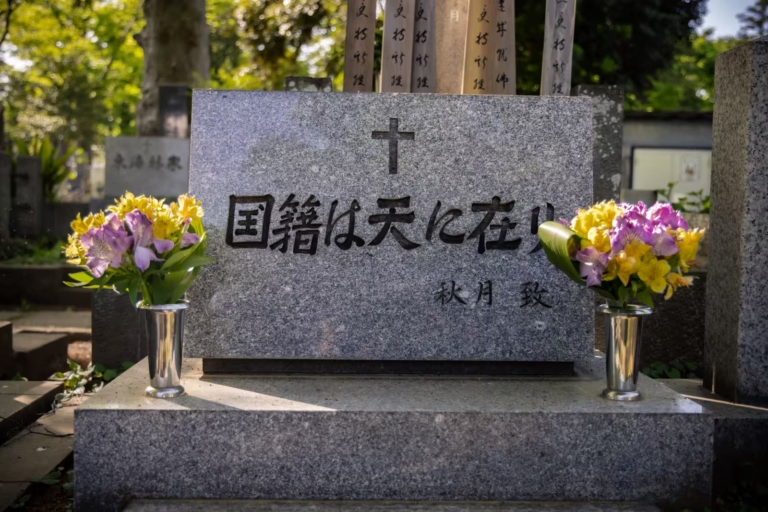
On September 26, 1904, Hearn died of heart failure at the age of 54. Today, he rests in Zoshigaya Cemetery alongside his wife, Setsu, and their son, Kazuo. Because Hearn was a naturalized citizen, his headstone bears his Japanese name, Yakumo Koizumi.
The grave is a beautiful, well-tended site shaded by trees. The tranquility of Zoshigaya reflects the respect Hearn still commands in Japan. Visitors often leave offerings, a common Japanese tradition, ranging from bottles of water to oranges and cans of coffee.
Navigating the map
The administration office provides a map of historically significant graves. Note a small discrepancy: Hearn’s grave is listed as number 25 on the key, but is often marked as number 24 on the map itself.
Photo tips for his grave
After taking my photos several years ago, I look at them and realize the mistakes I made. I should have shot wide open and blurred more of the backgrounds.
It might also have been a good idea to zoom in on the characters on the gravestones. Closeups of the kanji in the stone would look good. I’ll reshoot the pictures one day.
Lafacadio’s grave is well-covered by trees and can often be in deep shadow, so you might want to plan for that depending on which season you go. Use a sun calculator to see if you can get some natural light on it.

Etiquette for photographers
Zoshigaya Cemetery is a place of rest. Always prioritize mourners and keep a respectful distance. Avoid using tripods in narrow paths, as they can block access. Focus your lens on the textures of the weathered stone and the offerings left at Zoshigaya Cemetery.
How to get to Zoshigaya Cemetery
Zoshigaya Cemetery is located near Ikebukuro. The easiest routes are:
- On foot: A fifteen-minute walk from Ikebukuro Station.
- By tram: Take the Tokyo Sakura Line (Toden Arakawa Line) to Toden-Zoshigaya Station; the cemetery is just across the street.
- By metro: Take the Fukutoshin Line to Zoshigaya Station (be careful not to confuse this with the tram station).
Is it worth visiting the ghost story master’s grave?
Lafcadio Hearn’s grave is more than just a final resting place; it is a monument to a man who lived between worlds. He bridged the gap between East and West at a time when the two were deeply estranged.
While you are there, you can also pay your respects to other Japanese luminaries buried nearby, such as the novelist Natsume Soseki and the physician Ogino Ginko.